[Photo by Greg Gore on Unsplash]
The first iconic Australian animal that comes to our minds at Madeleine’s is the kangaroo, though we must confess we have a soft spot for the koala too.
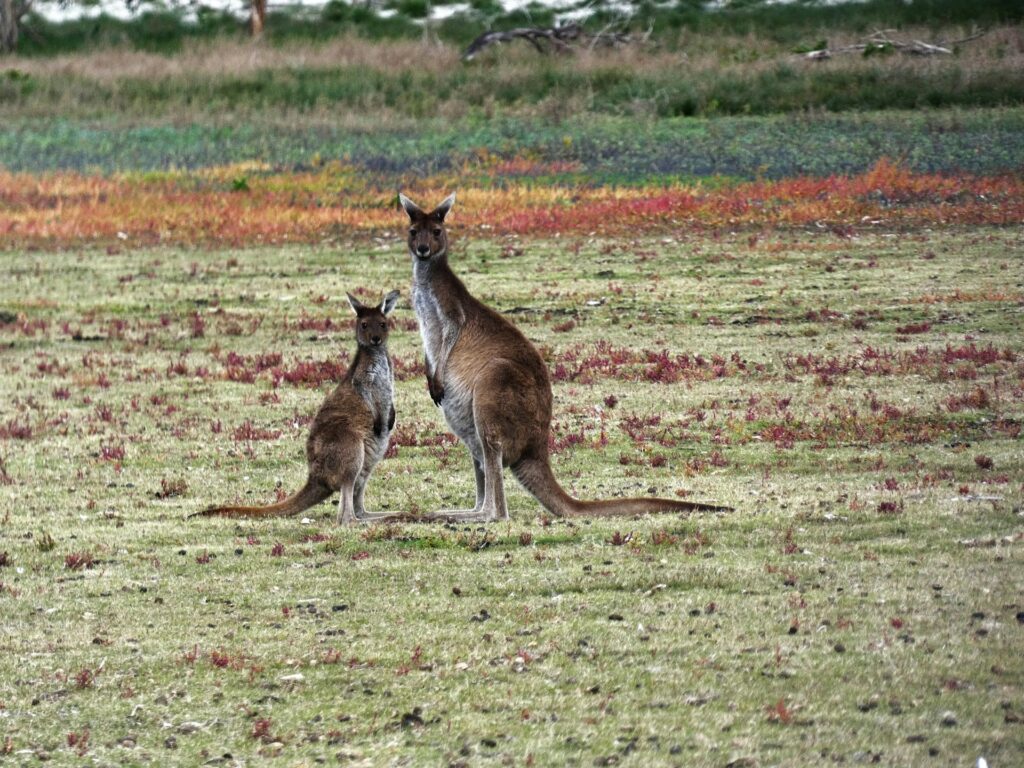
There’s definitely something about viewing kangaroos in the wild that is truly captivating. Whether it’s their seemingly sheepish stances, their inquisitive looks, or the way in which they appear to effortlessly yet gracefully bounce through the air, kangaroos are a constant source of fascination.
The only one large animal that move by hopping, kangaroos seem to move in surprisingly cute ways, although they can jump deceptively large distances, as their powerful hind legs can cover up to 9 metres in a single leap. As for their pouches (for carrying their babies, known as “joeys”) – though only the females have these – who can resist these?
And then there are the koalas, amongst Australia’s most iconic animals, and interacting with koalas in the wild is another uniquely Australian experience.
We at Madeleine recently revisited this a tiny island that makes us daydream a little: within about three hours’ drive to the east of Melbourne, this piece of rustic heaven is where you can find hundreds of wild koalas.
You drive or train to the town of Paynesville, about 200 miles east of Melbourne, and you’ll then need to take a five-minute ferry to reach the tiny island that is 6 km long and 2 km wide, sometimes known as koala island but is actually called Raymond Island (its indigenous name is “Bunjil-baul”).
The koalas can be found often amongst the eucalyptus trees, though it sometimes takes a trained eye to spot one of those, lazily perched into a notch of an eucalyptus tree or languidly munching on the tree-leaves, staring down with half-closed eyes.
We at Madeleines only learned about it from our colleague who is a true native who also told us that koalas sleep 20 hours a day to conserve energy for processing the eucalyptus leaves that they’re eating! (koalas feed exclusively on eucalyptus leaves)
If your love is for kangaroos – which by the way is also a herbivore, like the koala – you can often see them in the wild in any of the national parks or camping grounds in the country. We at Madeleine’s once went camping in the Grampians (also known by its indigenous name of Gariwerd), a National Park about 3 hours drive west of Melbourne, when we woke up to these lovely animals wandering around our tent. Dawn and dusk is when kangaroos tend to roam around.
Another Australian friend of Madeleine’s reminds us kangaroos cannot hop backwards. And if you are wondering what they do when they have to back-track, then you are the perfect audience for our Christmas quiz! Let’s just say some of us had to backtrack on the way-too-creative answers we invented. A fun lesson we can all learn from the kangaroos is to keep moving forward and if you had to backtrack you needed to turn around 180 degrees!
Not everything requires backtracking: if all you need is an excuse to do an island adventure in search of kangaroos, you most certainly should consider making your way to Kangaroo Island! You will have to get to Adelaide, the capital of the state of South Australia, and then take a much longer ferry (Kangaroo Island is separated from “mainland” by 13km) to the much larger island (in fact it is the third largest island in Australia measuring 155 km by 55 km with over 500 km of coastline and is a biodiversity hotspot.).
In fact, you can find koalas on the island too. Not only is Kangaroo Island (locals call it “KI”) known for its kangaroos outnumbering its human population by more than ten times, but the island also has one of the largest population of koalas in Australia.
Both kangaroos and koalas are native to Australia and are indigenous to the continent, where they have lived for million of years.
Koalas especially has been of much recent scientific interest not least because of their ability to sustain a toxic diet (they only eat eucalyptus leaves whose high oil content when consumed in high quantities are toxic), and they are currently the subject of a “genetic rescue” to prevent inbreeding due to their existence in small, isolated populations and the resulting loss of genetic variation (making them highly vulnerable to a phenomenon geneticists call the “extinction vortex”),
Other places to spot koalas near Melbourne:
- Great Ocean Road – especially around Cape Otway close to the Lighthouse, Shelley Beach, Blanket Bay, and Kennett River are some of the best places to find koalas.
- French island – this rugged, off-grid island two-thirds of which is a national park and is located next to Philip Island, where many tourists go to view penguins, still has a thriving population of koalas and many of Victoria’s “mainland” koalas can be traced back to this “offshore” island.
Other places to spot kangaroos near Melbourne:
- Westerfords Park – a metropolitan park situated in Templestowe, a north-eastern suburb of Melbourne, about 22km from the city and next to the Yarra River, this is perfect for an easy trip and in fact the Main Yarra Trail passes through the park too which means you can easily bike to the park also.
- Both ends of Great Ocean Road: close to the Great Otway National Park and Apollo Bay areas, there are frequent sightings in open grass sections, while the Anglesea end close to the Gulf Course is well-known for a large, resident mob that grazes on the fairways.


